®
® 


 ®
® 








Research shows that the coming decade will bring a massive increase in the importance of e-commerce and online shopping. The last two years alone have seen growth rates of 14% per year. An analysis by PwC shows that by 2026, the share of online shopping in our daily lives will increase by 12% year over year. This means it is the perfect time for anyone considering or planning to try their hand at e-commerce. For each of these individuals, we have prepared the 12 most important rules below — the secret to success for online sellers — a list of elements to consider when setting up an online store and mistakes to avoid so that your online store generates real profits.
Table of Contents
- How to create a store that sells?
- Building an online store — step by step
- Step 1. Choosing an industry and product range
- Step 2. Choosing an e-commerce platform
- Step 3. Essential integrations
- Step 4. Customer trust
- Step 5. Consistent communication
- Step 6. Transparent presence
- Step 7. Legal support in e-commerce
- Step 8. Payment methods
- Step 9. Social media and e-commerce
- Step 10. SEM = SEO + PPC
- Step 11. Digital marketing in e-commerce
- Step 12. An attractive offer
- Summary — make yourself findable
How to create a store that sells?
This is a very important question! After all, that is the reason an online store is created — to generate revenue, to sell, and to drive traffic. In our career, we have encountered a huge number of stores that were set up, prepared, stocked… and closed. It is very sad but unfortunately all too common in e-commerce. Many people are interested in opening a profitable online store and starting to earn money from it. Some succeed, but many stores close within their first year. So what is the key to success? What sets apart the stores that survived from those that were shut down? The most important step is planning. Simply opening an online store is not enough. It is a long-term process that requires planning, designing, a concept, consistency, refinement, optimization, improvements, and above all, marketing. Running your own online store is the result of all these elements. Some of them need to be thought through at the initial stages, while others are an ongoing task every single day — throughout the entire life of your online store. Below is a list of 12 steps essential to achieving success in e-commerce. Completely free of charge, we are giving you the recipe — the key that answers the question:
How do I set up an online store and make money from it?
step by step
Website Development
!carousel icon
Market Analysis
Every project starts with a market and competitor analysis to understand industry standards and expectations. Based on this, we select the right tone of communication, visual style, and strategic direction.
!carousel icon
Strategy
We thoroughly analyze industry specifics and leverage the client’s expertise to select solutions aligned with business goals. We design the content strategy and site structure so it’s effective and SEO-friendly from the start.
!carousel icon
Graphic Design
We develop a custom layout tailored to the brand, industry, and business goals. The design is discussed in detail and refined before development, ensuring full alignment with the company’s image and identity.
!carousel icon
Development
We transfer the approved design into WordPress or implement it in code — depending on the project requirements. We also help with domain selection and hosting configuration.
!carousel icon
Optimization
We boost site performance and implement full analytics using professional tools. After completing the work, we train your team on site management so they can independently manage content and monitor results.
!carousel icon
Administration
After launch, you can entrust us with ongoing site maintenance: WordPress updates, security, monitoring, and content editing support. You hand over the maintenance to us while the site stays reliable, secure, and fully operational.
From a technical standpoint, building an online store is no different from building a professional website (more on this topic in our blog post), so we will skip that part in this article and focus on the aspects that distinguish these two types of web portals from each other.
Step 1. Choosing an industry and product range
The first question every future online store owner should answer is:
What products will the store offer?
The answer, however, is not always straightforward. When entering e-commerce, you need to make sure you can handle the chosen industry and that the level of competition allows you to keep up — in terms of server quality, sales platform, and advertising budget. If the owner plans to sell handmade goods or services, the situation is somewhat different. There is not as much of that online yet, but it is definitely more difficult today to open an online store selling electronics, brand-name clothing, or cosmetics. There are already many companies online with very large advertising budgets, whose offerings can far exceed the capabilities of a small, starting store. Choosing the right industry and market niche will make achieving success significantly easier, without the need for massive advertising campaign budgets.
Step 2. Choosing an e-commerce platform
After deciding on the industry and product range, the next very important aspect is choosing a sales platform. The number of products and required performance determine which CMS (content management system) should be used to build the store. It is important to anticipate the number of products and how they will be sourced — not only at the time of launching the store but also in the future. Choosing the wrong content management system and store warehouse setup can hinder the platform’s future growth. A properly managed e-commerce business should grow at a fairly rapid pace, and it would be a shame for a developing store to become unusable within its first few months. The most popular platforms for building online stores include:
- WooCommerce (a WordPress plugin)
- PrestaShop
- Shoper
- IdoSell Shop
- Shopgold
- Click Shop
- Shoplo
- Magento
- skyShop
- Red Cart
These platforms are listed in descending order of popularity. The most popular platform in the world for building online stores is WooCommerce, based on WordPress. Thanks to its open-source nature, free access, and extensive customization options, WooCommerce gives developers the ability to create any type of store. However, this solution is not the best choice when the number of products grows significantly (into the tens of thousands). A MySQL-based database and PHP as the programming language become a less efficient solution.
Step 3. Essential integrations
An online store (regardless of the chosen platform) is equipped with integrations. These are connections with systems such as:
- Shipping,
- Payments,
- Invoicing,
- Wholesale suppliers,
- Newsletter
From the very beginning, it is worth considering who will be the provider for each of these services, and if necessary, establishing partnerships and signing contracts with each of these companies early on. Integration with a shipping system enables automation of waybill generation and eliminates the possibility of errors when manually copying data. Each of these integrations helps streamline the store’s operation and simplify its administration and maintenance, as well as the processing of received orders.
Ad: Professional online stores powered by WooCommerce AND BACK TO THE ARTICLE 🙂
Step 4. Customer trust
From this point on, every subsequent step is what is most often missing in newly launched stores.
After building an e-commerce store, the real work on its development only begins.
From this moment, it becomes one of thousands of stores online and certainly not the only one in its industry. This means you need to start working on building customer trust. Unfortunately, the internet is a place full of scams, bad stores, and people trying to deceive users. The customer must develop trust in the website, and that is not easy. As a society, we are becoming more cautious in our e-commerce activities every day. Even the smallest element that raises doubt can deter a potential customer from making a purchase. Communication should be consistent and transparent, and the website should be refined in terms of UX (user experience). But what does that really mean? The shopping path in e-commerce, product descriptions, legal documents, and the store’s image should meet customer expectations and be smooth enough to seamlessly guide the customer through all necessary steps and information. The website should not be the only place where people can learn about the brand. The evolution of the web means that trust in e-commerce is built through an overall analysis of the company — from checking the Google Business listing, through social media profiles, to all reviews about the brand online. You must ensure that the brand vision is consistent and leaves no doubt about the authenticity of the products offered. At this stage, it is worth considering whether adding cash-on-delivery shipping to the store might be worthwhile. This option allows people who are not fully convinced to take the risk of placing an order without paying upfront.
Step 5. Consistent communication
Another element that requires constant work is communication consistency. Branding and the brand vision should be standardized. Every professional brand has a so-called brand book — a document presenting the company’s color palette, its visual identity, and the way the brand is identified. In brand communication, certain guidelines must be followed to build trust and professionalism behind the brand and its identity.
Step 6. Transparent presence
Image is fundamental, and the next important step in building it is transparency. In brand communication, it is worth including all elements that matter in the purchasing process. If for any reason delivery time may be extended — the customer should be informed. When organizing contests, it is important to present the rules, and any additional costs or elements that might affect how the brand is perceived in the e-commerce world should be communicated to the customer at the earliest stage. Transparency is a quality that helps build trust and be perceived as a trustworthy brand.
Step 7. Legal support in e-commerce
In today’s world, proper legal support for your store is very important. When planning to enter e-commerce, several basic legal documents must be prepared to protect the store owner from fraud and to inform customers about the aspects of placing an order. Customers should be informed about available payment methods, how personal data is used, and whether it is shared with third parties. If analytics or tools such as newsletters are used, customers must be informed about how their data will be stored and shared.
Transparency must also be maintained in matters related to return policies and order cancellations — all these elements should be described in the store’s legal documentation. As the store grows, it is also worth considering permanent legal support provided by a law firm — this will ensure peace of mind and help in case of any issues arising from customer interactions.
Step 8. Payment methods
Purchase intent in e-commerce is also built by offering the payment method the customer prefers. But which method is that? This is another question without a simple answer. Larger providers of automated payment services offer a very wide range of available methods — from card payments, through automatic bank transfers, bank payments, BLIK, QR codes, to mobile payments that have emerged in recent years (Apple Pay and Google Pay). It is important to remember that over 80% of traffic on websites comes from mobile devices. That is precisely why the smoothness and ease of making a payment can turn out to be the crucial aspect that deters a user from completing a purchase. This conclusion can be reached by analyzing the number of orders that are placed but not paid for, as well as the number of abandoned carts in the store. All this information can be obtained from the store’s admin panel as well as from Google analytics tools.
Step 9. Social media and e-commerce
There are many myths surrounding social media management. Some consider it an unnecessary element, while others have exceptional faith in its effectiveness for acquiring customers. In our opinion, social media and a brand’s presence within it is an important element of the communication consistency mentioned above. Users browse different places to gather information about a brand, build trust, and learn more. A great place to share brand news is Facebook or Instagram. Social media offers the opportunity to showcase the product range, share information about current promotions, and conduct digital marketing. A presence on social media also helps build domain trust and indirectly affects organic search rankings. When creating content, the goal should be comprehensiveness and consistency of the message — regardless of whether it is a website, blog, social media, or product descriptions.
Step 10. SEM = SEO + PPC
In the early stages of running an e-commerce store, you can use SEM (search engine marketing) to acquire customers — that is, marketing in search engines. It consists of SEO (search engine optimization) and PPC (pay per click) — meaning organic search result optimization and paid search results. A good example is typing the following phrase into Google:
website development:

The first two results in the screenshot above are paid results. This means the only way to appear at the top of search results is to pay for advertising campaigns targeting specific keywords. Below the paid results, there is usually a location map. And only below that do the organic results appear — those that require no payment, and whose order depends on Google’s assessment and SEO efforts. It is undeniably a long and complex process to get a website to the top of search results for any keyword, due to intense competition and Google’s complex algorithms aimed at making it increasingly difficult to manipulate organic results. Therefore, the only method that can realistically generate revenue in the early stages of a store’s existence is advertising. There are different types of campaigns, but regardless of your choice (for assistance, feel free to contact us), they deliver real results, and costs are incurred only when someone actually clicks through to your site from the displayed ad. In all other cases, the fact that a user saw the campaign costs nothing, while it automatically places your site above organic results and the location map.
Step 11. Digital marketing in e-commerce
Since we have already mentioned that digital marketing is the foundation of running an e-commerce store, we should also present a few basic advertising campaigns that can help increase online sales. When preparing to run advertising campaigns for an e-commerce store, a useful tool from Google is Merchant Center. The sales center is used to upload products from the store to enable marketing directly on those products. This is precisely why the first campaign worth recommending is Google Shopping:
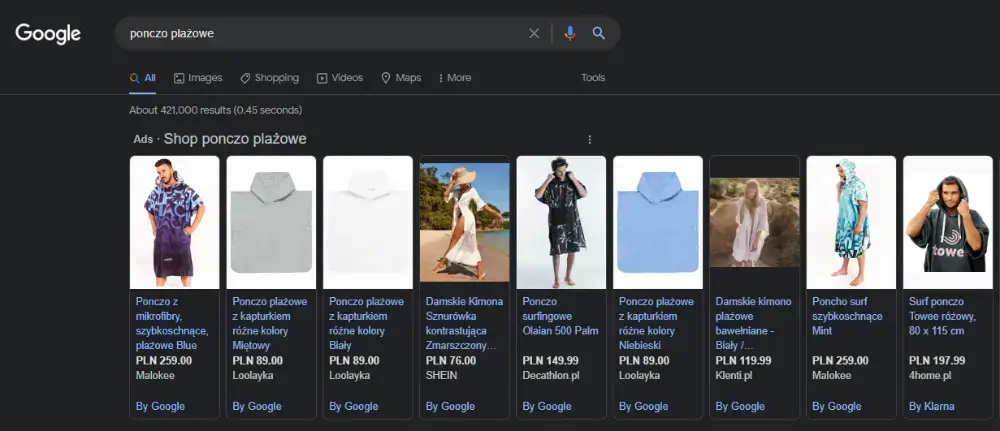
This is a mechanism that displays product ads in Google search when users search for specific products — for example, a beach poncho. Today, it is by far the most efficient advertising method in Google for small stores, and every store just starting its marketing journey should use it. E-commerce is the art of attracting customers to your products. This is why an ideal accompanying campaign can be a Facebook shop. It enables showcasing the online store’s offerings through photos, graphics, and sponsored posts displayed in the feeds of interested users. Finally, of course, the most important campaign is search. Every business should run a campaign based on paid search results. It is a method that allows closing transactions. Thanks to paid search results, a company’s offering will appear at the very top of search results for specific keywords and the company name. If a given store fails to capture and pay for such searches — the competition can.
Step 12. An attractive offer
Step 12 — the final one -> what sells in an online store above all is the OFFER! Every owner should ask themselves — what makes their store stand out from others in the industry. Constantly adjusting the offer and creating attractive promotions or deals is a good start and a solid foundation for drawing the customer’s attention to the product range. Running an e-commerce store requires continuous work. It requires adapting the offer to constant changes. You must remember about seasonal promotions, holiday offers, and sales. Promotion has always been the driving force of commerce.
Summary — make yourself findable
Your own e-commerce store comes with many challenges and a lot of work that needs to be done to increase interest. There are many stores online, and every one of them would like to sell effectively and quickly. Unfortunately, many people do it wrong and believe that creating an online store is the first and last step needed to start selling. In reality, it is just the beginning. In e-commerce, success is achieved through hard work, an advertising budget, and creative ideas. Only a properly tailored advertising campaign, an offer adapted to the ever-changing realities of the world, and a consistent brand identity will allow potential customers not only to find the store but also to build trust and make purchasing decisions.
If you experience any problems with store configuration, sales, or building its branding, please contact us. We will be happy to help!