®
® 


 ®
® 







Cookies, cookie files – I don’t know how many other names they go by, but regardless of the name, the issue remains the same! The eternal question of website owners: do I use them, and do I need to inform users about it? In this article, I’ll try to answer all of these questions.

Cookies – Where Are They and How to Find Them?
Let’s start from the beginning:
WHAT ARE COOKIES?
Cookies are small files saved and stored on your device. They appear when you browse various websites on the internet.
A cookie file contains information about:
- Its lifespan,
- The name of the generating website,
- Browser information.
Cookies are text data stored on the end device and are used to optimize the process of using a website. They are used to store and collect statistical data and to identify website users.
Cookies can be deleted and blocked in your browser!
Next to the address of the page you’re currently reading, you can see a padlock. This means it’s secured with an SSL certificate, which we wrote about here. If you click on that padlock:
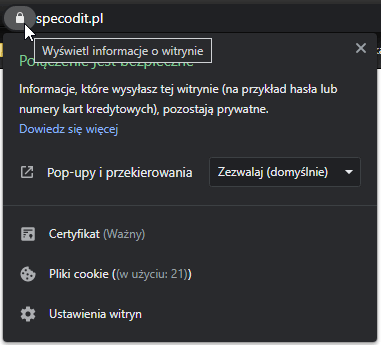
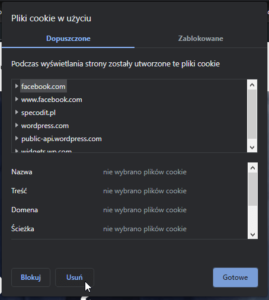
you’ll see the images above. Selecting the cookies tab will show what a given website has “left behind” in your browser. In the case of specodit.pl, these are Facebook, WordPress, and the site itself. We store information about the user’s chosen cookie policy, login status, and analytics.
WHAT CAN COOKIES BE USED FOR?
I’ve already mentioned this briefly, but let’s organize the information:
- Cookies allow saving user preferences and optimizing website usage,
- They enable creating statistics and understanding how users interact with the website,
- For large portals, they customize content for each user,
- They remember user sessions (login status and authorization level).
Simply disabling cookies doesn’t change or hinder the way a website is browsed. Every browser allows you to block cookie storage on your computer. Every service, in accordance with current law, should also inform users about how, what, and why it uses cookies. The user should explicitly accept and consent to storing such files on their computer. This is what “cookie banners” are for. On our homepage (if they haven’t been accepted yet), detailed information about data processing is displayed. It’s a banner at the bottom of the page and is a mandatory element.
The reason behind all this is Article 173 regarding cookies in the Telecommunications Law. The purpose of this change is to increase internet users’ awareness about the technologies used to deliver content better tailored to their preferences and interests. The procedure, effective since March 22, 2013, requires website owners to obtain users’ consent for storing and using cookies. This consent can be expressed through browser or application settings, in which case websites must first inform users about the use of cookies.
Many CMS systems (like WordPress, Drupal, etc.) offer the ability to add (natively or through plugins) a banner that complies with European requirements and standards.
If you’d like a cookie banner on your website but don’t want to set it up yourself – leave it to us!
Feel free to contact us! And have a great day!